BifacialMAX

Bifacial PV Is a System Architecture Question, Not a Module Specification
As photovoltaic penetration increases, the role of PV in power systems fundamentally changes.

The relevant question is no longer how much energy a plant produces annually, but how this energy interacts with the grid: when it is delivered, how predictable it is, and what system resources are required to absorb it.

From this perspective, bifacial photovoltaic installations should be evaluated as power-system assets, not as standalone energy generators. Their real contribution depends less on module-level parameters and more on construction geometry and spatial configuration.

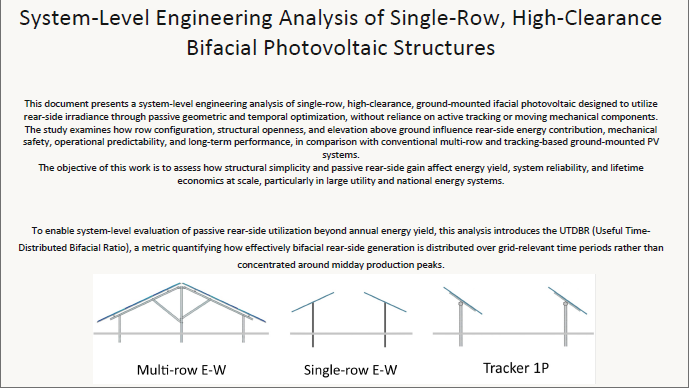
Height above ground, structural openness, row spacing, and orientation determine whether rear-side irradiance is physically accessible. In dense, low-clearance layouts, rear-side potential often remains theoretical.

In contrast, high-clearance, narrow, single-row architectures allow reflected and diffuse radiation to reach the rear surface throughout the day, turning bifacial capability into effective energy input.

Orientation further defines system relevance. East–West single-row layouts redistribute generation in time: enhancing morning and late-afternoon output while reducing midday concentration. This temporal shift aligns production more closely with typical demand profiles, lowers curtailment exposure, and reduces pressure on short-duration storage without relying on operational intervention.

At high penetration levels, these effects directly influence system cost. Storage capacity, ramping requirements, grid congestion, and reserve margins increasingly dominate total LCOE. Architecture that moderates peaks and extends useful generation windows can materially reduce these flexibility costs.

Structural logic also matters over decades. Simplified load paths, clear boundary conditions, and statically determinate arrangements limit stress accumulation from tolerances, settlement, and thermal cycles. This improves long-term reliability, safety margins, and predictability of operating costs—factors that become critical at national scale.

The key point is not technology preference, but system behavior.
Bifacial performance emerges from geometry, not from datasheets. When photovoltaic systems are designed around height, openness, and time-aligned generation, bifaciality becomes a tool for improving grid integration rather than merely increasing annual yield.

A more detailed technical analysis of this system-level approach is summarized in the attached note.

Zalety UKRYTE

Specjalistyczna konstrukcja naziemna 1x5 BifacialMAX

Image Not Found

Maksymalna opłacalność

Stabilna produkcja energii w ciągu dnia zmniejsza koszty magazynowania, wyższa wydajność modułów bifacjalnych podnosi przychody z inwestycji.

01
Image Not Found

Niższe koszty eksploatacji

Konstrukcja z profili zamkniętych wymaga mniej konserwacji, a odporność na warunki atmosferyczne gwarantuje długowieczność systemu.

02
Image Not Found

Ekologiczne podejście

Zrównoważona produkcja energii zmniejsza zapotrzebowanie na zasoby naturalne, wydłużona żywotność systemu ogranicza generowanie odpadów.

03

13 Lat doświadczenia

Bezpieczeństwo p.poż

Dlaczego my?

01

Maksymalna produkcja

W tradycyjnych systemach wielorzędowych, nisko montowanych nad gruntem, tył modułów jest często zacieniony przez elementy konstrukcyjne oraz sąsiednie rzędy paneli, co powoduje spadek produkcji energii nawet o 50%.

02

Wyższy montaż – większe korzyści

Nasza specjalistyczna konstrukcja przeznaczona do dużych farm fotowoltaicznych na moduły zamontowane na wysokości 110 cm nad gruntem, co minimalizuje straty energii spowodowane odbiciem światła od podłoża i zacienieniem.

03

Konstrukcje do Agri PV

Wersja agro-fotowoltaiczna, stworzona specjalnie do zastosowań w rolnictwie, posiada moduły na wysokości 210 cm, co pozwala na efektywne wykorzystanie gruntu pod modułami, np. na uprawy lub wypas zwierząt, jednocześnie zwiększając efektywność energetyczną.

04

Optymalna Szerokość Stołów

Nasze stoły mają zoptymalizowaną szerokość, co redukuje powierzchnię zacienienia między rzędami paneli, zapewniając lepsze doświetlenie i wyższą produkcję energii.

05

Gwarancja stabilności i bezpieczeństwa

Konstrukcje wykonane z profili zamkniętych zapewniają maksymalną stabilność i bezpieczeństwo. Dzięki ich wyjątkowej odporności mechanicznej eliminujemy ryzyko pękania tylnej szyby modułów bifacial, co najczęstszym problemem w instalacjach na całym świecie

06

Dlaczego wybrać Bifacial Max?

Wybierając Bifacial Max, inwestujesz w przyszłość fotowoltaiki – wydajniejszą, bezpieczniejszą i bardziej ekologiczną. Skontaktuj się z nami już dziś i dowiedz się, jak nasze rozwiązania mogą zwiększyć efektywność Twojej instalacji!